
How Confidential works
The application behind private Solana payments and native shielded Zcash, and the limits we tell you up front.
Where your money lives
Your Phantom stays your normal wallet. Confidential doesn't replace it or change it. It's the front door.
Your private balance sits next to it, on Solana. It lives in a shared private pool, and only the keys on your device can open your share. You pay, get paid and fund app wallets from here.
Your Zcash wallet is optional. The Shield moves money into it for the deepest privacy, and one tap brings it back. You never need to own ZEC first.
Sign in and your vault
Connect the wallet you already have: Phantom, Backpack or Solflare. Then open your vault. The first time, pick a password and copy your encrypted recovery code. The keys for your private balance are made on your device and locked in the vault, so a fake site can't get them, even if your wallet signs what it asks. Our servers cannot spend anything.
Your wallet itself stays public, as every Solana wallet is. What becomes private is the money you move into your private balance: from then on, what you do with it isn't linked to your wallet on chain. Moving money in from your wallet is the one public step; an exchange or anyone else can also pay your privacy address, and then your wallet never shows up at all.
Your privacy address
You get one reusable privacy address. It holds three public keys, so anyone can pay you with it and only you can find and spend what they send.
Paid from Confidential, the money moves inside the protocol straight to you: the chain never shows the amount. Paid from any wallet through your pay link, it lands at a fresh one-time address only you can open, and your app moves it into your private balance. Either way, two payments to you can't be linked by reading the chain, and you don't need to be online to receive.
cm1…
Adding funds
You move SOL, USDC or ZEC into the Solana privacy protocol. Each deposit is checked against sanctions lists on the way in, and flagged funds are refused.
A deposit from a public wallet is visible at that moment, because it leaves a public wallet. From then on, your balance and what you do with it are private.
Private payments
Pay a privacy address, and the amount never appears on chain. Your app hands them a note inside the protocol, sealed so only their app can open it, with a proof that authorises the spend without showing the amount or who paid whom. The only thing that leaves the protocol is a small fixed delivery to a one-time address, the same for every payment, which pays for them to collect it.
Pay anyone with a link. No account needed on their side. They open the link and add the money to a private balance, or send it to their own wallet. Nothing on chain links it to you. Anyone holding the link can claim it, so send it privately.
Pay any Solana wallet. The money leaves the protocol straight into their wallet. They and the chain see it arrive and how much; the chain doesn’t show it came from you or what you hold.
A relayer submits payments and pays the Solana fee, so your public wallet never appears. The protocol checks every proof and stops any double spend.
Your app does the reading. It downloads encrypted protocol events and recognises your payments on your device. Our backend never decrypts your balance or your history.
The Shield and Zcash
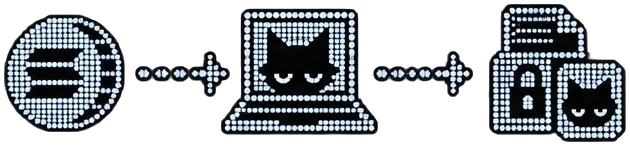
NEAR Intents handles the cross-chain exchange. Pick SOL, USDC or ZEC from your private Solana balance; the app shows the route, expected output and available fee information before you confirm. NEAR Intents delivers native ZEC to a transparent Zcash address controlled by your wallet.
Zcash provides shielded storage and transfers. After the arrival confirms, your built-in wallet shields the received ZEC on your device. Its keys come from the same vault as your private balance, so your complete backup restores both. To return to Solana, NEAR Intents exchanges ZEC for SOL, which returns to your private balance.
Route deposits, withdrawals, amounts and timing remain public. NEAR Intents and its route providers can observe route metadata. Confidential routing does not guarantee anonymity.
The Shield takes minutes, not seconds: Zcash adds a block about every 75 seconds, and the trip crosses two chains.
Moving out
You can move funds back to a normal wallet whenever you want. Before you confirm, the app shows the destination, the fees and exactly what becomes public.
Even without the relayer. Your app builds every transaction itself, so if the protocol's relayer is down, your own wallet can sign a withdrawal and send it to Solana directly. The chain then shows your wallet paying that wallet. And if Confidential ever went away, the same wallet opens the money you made private in the protocol's own app.
Using apps privately
Every app gets its own fresh wallet, filled from your private balance. Jupiter, Kamino and pump.fun each see a different wallet with no history, so the chain doesn’t link them to each other or to you. Each app still sees what you do there.
You make the fresh wallet in Phantom (Add account, then Create new) and Confidential fills it privately. A wallet that only gets USDC or ZEC also gets a little SOL, so it can pay Solana's fees. When you're done, bring the money back: in Confidential, with your main wallet, open Make private, pick From an exchange, and send to that one-time address from the app wallet. It lands in your private balance without linking the two.
Proof of source
Privacy only works if honest money can prove where it came from. Every deposit is checked against the US sanctions list, and flagged wallets are refused before anything is signed.
A private proof shows that a payment was made only with money that traces back to screened deposits, without revealing which deposits. Your app makes a zero-knowledge proof for every transaction, so your money stays on the approved list as you use it. Notes join that list only with such a proof, and money coming in only from wallets (and their funders) that pass screening. Anyone can check a proof at /proof.
A full receipt goes further when someone needs it: it traces one payment back to the exact deposits behind it, checkable at /receipt. Whoever you show it to sees those deposit wallets and amounts. Never your keys, your balance or your other payments.
That is why Confidential is not a mixer. A mixer hides where money came from. Confidential keeps your money sealed while you use it, and proves where it came from when you ask it to.
A new device
Lost your phone or switched laptops? Connect the same wallet and choose “I have a recovery code”. Your saved code and its password open the same private balance on the new device.
Your money never depends on our servers: the app can withdraw it straight to your wallet without them.
The roadmap
Launch is your private balance on Solana and everything you do with it: make SOL, USDC or ZEC private, pay privacy addresses with no amount on chain, pay anyone with a link and use apps from wallets that aren't linked to you, prove where your money came from, and shield into Zcash.
A mixer stops at hiding where money came from. Confidential is the home around your money, and each stage adds a room: a kit so any app can offer private payments, more tokens, and private earning. These are future plans, not available features or delivery dates.
Honest limits
Privacy tools earn trust by saying what they do not hide. These are ours.
- Deposits from a public wallet are visible. Money entering the protocol from a public Solana wallet shows on chain at that moment. Public withdrawals and cross-chain route deposits remain visible. Amounts and timing can suggest links.
- Public withdrawals are public. When you move funds out to a public address, the destination, asset and amount of that withdrawal can be seen. The app shows this before you confirm.
- App wallets show what you do in that app. A fresh wallet for an app hides who you are, not what you do there: the app and the chain still see that wallet's trades.
- NEAR Intents routes the exchange. NEAR Intents exchanges funds between Solana and native ZEC. Route deposits, withdrawals, amounts and timing remain public. The provider can observe route metadata; confidential routing does not guarantee anonymity.
- Our server sees your IP address. Requests go through us so Solana nodes and the pool's server never see it. We don't keep logs, but that is a promise. For protection that doesn't rely on us, use a VPN or Tor.
- A sanctions check isn't a guarantee. It refuses wallets on the US Treasury sanctions list. It can't prove where money was before that wallet.
- Your vault is your key. Your private balance opens with the vault on your device, or its saved recovery code and password on another one. Lose the device and the backup, and you lose it.
- ZEC on Solana is bridged. It's ZEC carried over from Zcash, and its bridge handles redemption. On Solana it's private because of our protocol, not Zcash. The Shield moves you onto real shielded Zcash.
- Privacy grows with use. The protocol already holds over 800,000 notes. Matching amounts and timing can still hint at links, so the app warns you when they match.
- The complete application has not been independently audited. The application is deployed. No independent audit of the complete application has been published; underlying protocol audits do not cover its integrations.